
Hito-Kane-Mono: People, Money, Things—and the Systems Between Them
A Japanese management idea for understanding how people, money, and things work together, and why owning resources differs from being able to use them.

An institution invests in a state-of-the-art laboratory.
The equipment arrives and is commissioned by the vendor. Staff are trained. The project manager declares readiness. The investment appears in the annual report.
A year later, the equipment stands idle, the trained staff have left, and the vendor has not been fully paid.
The explanation is rarely that the equipment was a bad idea. Perhaps the people who should have received the training were never hired. Perhaps they were hired but never given time. Perhaps the lab should have been attached to a different organizational unit. Perhaps the budget covered the purchase but not maintenance, consumables, or business development. Perhaps the laboratory was built without a clear connection to the people who might use it. Perhaps… you get the point.
The building exists. Machines stand in it. Money was spent. And yet the capability does not exist.
This gap between what an organization possesses and what it can actually achieve sits at the heart of hito-kane-mono.
Three words, one question
Hito-kane-mono —人・金・物— is a Japanese management expression commonly translated as:
- Hito: people.
- Kane: money.
- Mono: things.
At first glance, the phrase looks like a simple inventory of organizational resources. People do the work. Money pays for it. Things provide the tools and infrastructure.
The phrase is more useful as a question than as a list:
How do people, money, and things come together to create—or prevent—the outcomes we want?
How I encountered hito-kane-mono
When I studied industrial engineering in the mid-to-late 2000s, excellent professors taught me organizational theory and the different views of the firm. Entering industry, I soon learned how distinctly Western that way of looking at things was. At P&G, working in EMEA logistics automation, I was introduced to Japanese production philosophy: kaizen (改善), the seven types of waste (muda, 無駄), the five pillars of 5S, and much more. I had lived in Japan as a child, and it resonated naturally. Later, at AUDI and delivering solutions with PwC, I saw how far Japanese management philosophy had traveled across industries. It was not always implemented well, and at times it sat uneasily with company culture. But I kept finding it useful to return to its core tenets.
Hito-kane-mono was not among them. Perhaps I had come across it before, and it was not the right time or place for it to matter.
I heard it in the United Arab Emirates. A colleague and researcher who had earned his PhD in Japan used the phrase almost in passing while we were discussing research strategy and the lab infrastructure it required. Three words sorted every challenge and every bit of progress neatly into three categories and made the way forward easier to communicate. More than that, the interaction between the three explained the gaps and showed where the system needed development.
That conversation is why this site exists under this name. I write about what fascinates me: organizations and leadership, institutions and policy, higher education, research, data, and the decisions that run through all of them. Almost every one of these subjects turns out to be a question about how people, money, and things are connected. Hito-kane-mono gave me a name for the habit of asking it.
Where the idea comes from
The expression comes from Japanese business and management practice. I have found no reliable basis for attributing it to one person or a definitive moment of origin, and it would be misleading to present one.
It reached many English-language readers through the Japanese strategist Kenichi Ohmae. In The Mind of the Strategist—published in Japan in 1975 as Kigyō Sanbō (企業参謀) and in English in 1982—he describes hito-kane-mono as a favorite phrase of Japanese business planners and argues that effective management requires attention to all three resources.
His argument is: resource allocation means more than allocating money. An organization may have funds but lack people who can put them to productive use. It may have talented people but give them neither the resources nor the authority they need. Or it may possess valuable facilities and technologies that are disconnected from any meaningful strategy.
Ohmae placed the resource question within a wider discussion of strategy. A strategy, in his account, requires an understanding of the customer, the company, and the competition—his 3Cs, set out in the same book. But a strategic idea also needs the right combination of people, money, and capabilities behind it.
Two details for how I use the phrase.
First, in Japanese usage today a common order is hito-mono-kane (ヒト・モノ・カネ), and the list is routinely extended—most often by information (jōhō, 情報), sometimes by time, intellectual property, or brand. I keep Ohmae's order because it is the one I encountered, and three words because they are memorable. Information I fold into mono, for reasons explained below.
Second, the idea that owning a resource is not the same as being able to use it has a long pedigree in management theory. Edith Penrose argued in The Theory of the Growth of the Firm (1959) that it is never resources themselves that enter production, but the services they can render. Hiroyuki Itami later made the case that a firm's invisible, information-based assets are often its most important ones (Mobilizing Invisible Assets, 1987). Hito-kane-mono compresses all that vocabulary into three words that work in a meeting.
What hito-kane-mono means here
For this site, hito-kane-mono is a starting point for examining the interaction between people, resources, and the systems through which decisions become outcomes. That calls for a broader reading of each term.
Hito: people are more than a workforce
People bring skills, judgment, creativity, experience, and ambition. They also have needs, responsibilities, relationships, and limits.
An organization may describe people as its most important asset. Yet its structure may quietly keep them from contributing, learning, and exercising judgment.
People may be flexible, but they are not interchangeable units that can be moved around a chart without consequence. Nor are they simply inputs into an economic model. They are participants in—and often the intended beneficiaries of—the systems we design.
Kane: money is a signal as well as a resource
Money enables activity. It pays salaries, funds research, buys equipment, and provides security. But money also communicates priorities. Budgets reveal which activities are sanctioned, which risks are accepted, and which ambitions remain statements.
The distribution and timing of a budget matter as much as the headline amount. A large capital allocation without an operating budget can create an impressive asset and an expensive problem.
Financial rules also shape individual choices. What people are allowed to keep, what they must contribute, and what they can expect in return all affect how they navigate a system.
Mono: things include what we can actually use
In Ohmae's discussion, mono covers physical assets and productive capabilities. Here I extend it to infrastructure, technology, processes, data, and the tools through which work is done—including much of what Japanese practice lists separately as information. I do not claim this is the standard definition.
The distinction I care about is between possessing something and being able to use it. A database without access or quality is not much of an information capability. A laboratory without technical support is not a functioning research platform. A strategy without decision rights and implementation capacity is a document.
From resources to relationships
Consider the laboratory again.
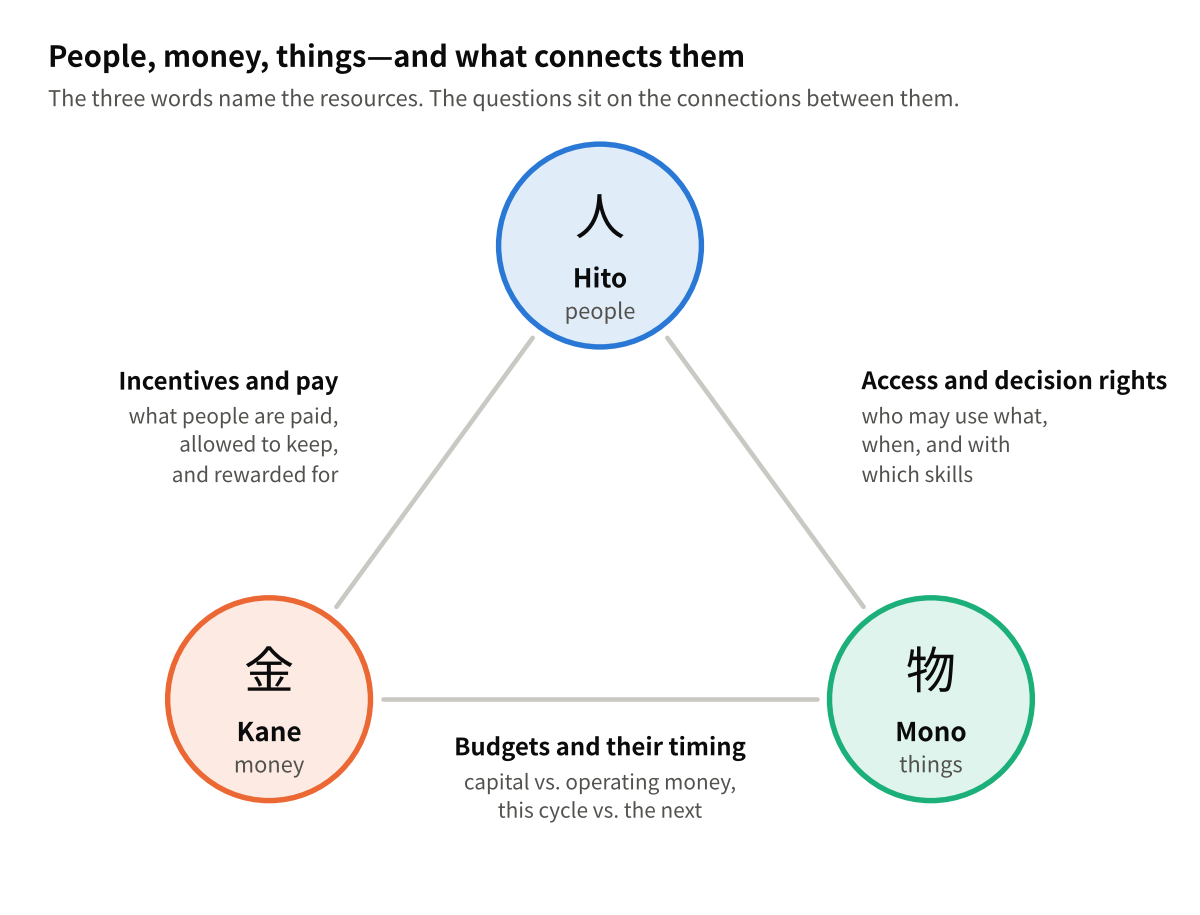
The equipment belongs to mono. The budget belongs to kane. The researchers, technicians, students, and partners belong to hito. We have named the elements, but we have not described what happens between them.
Who decides which projects receive access? Who controls the operating budget? Are technicians rewarded for supporting outside users, or only for serving their own department? Can researchers schedule time on the equipment? Does the institution measure the number of machines it owns, the number of hours they are used, or the value created through their use?
These questions point to something beyond the three resources themselves: the system connecting them.
An organization can have highly capable people, substantial funding, and excellent infrastructure, yet struggle because its rules keep them apart. A less richly resourced organization may achieve more by connecting what it has more effectively.
The resources are important, but their value depends on the relationships, decisions, and incentives through which they are used. This is where hito-kane-mono becomes more than a management phrase: a way of looking at systems.
What systems thinking adds
Systems thinking starts from the observation that the behavior of a system emerges from the interaction of its parts.
A university, a labor market, a research ecosystem, or a family cannot be fully understood by examining its components in isolation. Each contains people, resources, institutions, and rules that influence one another over time.
Systems can be described through stocks, flows, feedback loops, delays, information, and rules (Donella Meadows, Thinking in Systems: A Primer, 2008). These concepts move us from asking what a system contains to asking how it behaves.
Take a research institution. Its accumulated expertise is a stock. Hiring and development increase it; departures and lost experience reduce it. Funding allows projects to proceed, which may create results, attract partners, and support future funding. That can create a reinforcing feedback loop:
Relevant capability → successful projects → stronger partnerships → more resources → stronger capability.
The same institution can also move in the opposite direction:
Unused facilities → fewer results → reduced support → loss of expertise → even less use.
Neither outcome is determined by the equipment alone.
Time
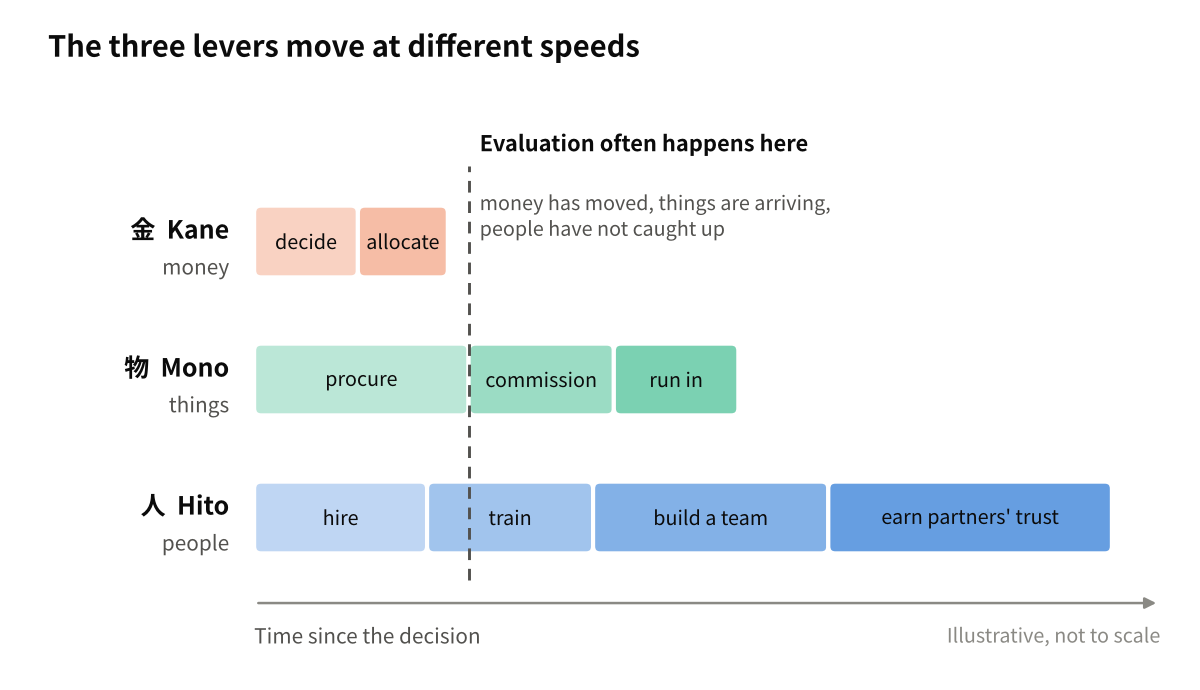
Systems respond at different speeds. A new funding program can, depending on the governance involved, be announced quite easily. A laboratory may take years to procure and commission. Developing an experienced technical team can take longer still. Building a trusted research partnership may require a series of successful projects.
When leaders ignore those delays, they may judge an initiative too early—or keep funding an approach that has not yet revealed its weaknesses.
Changing kane today does not immediately change hito or mono.
That asymmetry creates a recurring temptation. Money is the fastest lever and the most visible one: a budget line can be decided, announced, counted, and reported within a single cycle. Things take years; people take longer. Institutions therefore tend to steer through kane, announce the result, and evaluate it before hito and mono have had time to respond. The laboratory at the top of this essay is a typical outcome: the capital was approved in one budget cycle, and the people who would make it productive were left to a later one.
Incentives
People respond to the environment around them. Not always predictably, and not always in the same way—but rules, rewards, constraints, and information shape the choices available to them.
If a university says it values collaboration but promotes academics almost exclusively on individual publication counts, the system sends two different signals. University leadership needs to see that.
If a government says it wants people to work more, but the interaction of its rules sharply reduces the benefit of earning more, the financial incentive may point in the opposite direction (an example from German child support). The government needs to see that.
If a company says it wants innovation but punishes every failed experiment, employees will notice the difference between ambition and reality. The company needs to see that.
The recurring question is:
What behavior does the system actually encourage?
That question does not assume that people are purely economic actors. People care about purpose, security, fairness, recognition, relationships, and much else. But a system that consistently ignores the consequences of its incentives should not be surprised when its results differ from its intentions.
Why keep three words?
A fair objection follows. If outcomes depend on the rules, incentives, and timing that connect people, money, and things, then the system does the explaining, and hito-kane-mono is merely an inventory. Why not simply call it systems thinking?
Because the inventory is where analysis most often goes wrong first. Budgets, annual reports, and policy announcements are each organized around one of the three—usually kane, sometimes mono, rarely hito—and the other two enter only as assumptions. The three words work as a completeness check: before asking how a system behaves, ask whether all three are actually present, in usable form, at the right time. Systems thinking then explains what happens between them.
The name describes the parts. The analysis happens where they meet.
A lens, not a law
A second objection: a lens that applies to everything risks explaining nothing. "Outcomes emerge from interactions" is true of every organization ever built.
The lens does not say which of the three matters most. That depends on the situation. In one case the binding constraint is a financial rule; in another, a team that was never given time; in a third, an asset no one was set up to use. Some essays here will be almost entirely about kane, others about hito or mono.
What the lens does claim is narrower: an outcome is rarely explained by one element alone, the element that is easiest to change is seldom the one that binds, and the mismatch between the two is usually where intention and result part ways. Where that does not hold, I will say so.
What to expect here
The subjects explored here may appear unrelated. One essay examines the incentives created by a financial rule. Another questions an organization's approach to onboarding. Another asks how education systems prepare people for a future labor market.
The underlying questions are always connected:
- What are people being asked to do?
- What resources and capabilities are available to them?
- What do the rules reward, discourage, or make impossible?
- Who makes the decisions—and who experiences the consequences?
- How do today's decisions shape tomorrow's options?
The approach is consistent even when the form is not. I analyze mechanisms and incentives rather than motives, and where an analysis could be mistaken for a moral claim, I separate the two. I work from primary sources—statutes, statistical series, original studies—and make the argument quantitative where the topic allows, with worked examples and calculations you can check. Some pieces are long data essays with a methods note; others are shorter observations or unfinished thinking. I publish when an idea is ready, not on a schedule.
These questions can be applied to a laboratory, a business, a public institution, or a policy affecting millions of people. The answers will differ. If they are not interesting, the path to them should be.
Three words. Many possible futures.
Hito-kane-mono began, for me, as an expression shared by a researcher I respect. Over time, it became a way to examine the distance between what systems intend and what they produce.
People, money, and things are always present in some form. The work is in what connects them—and in what follows.